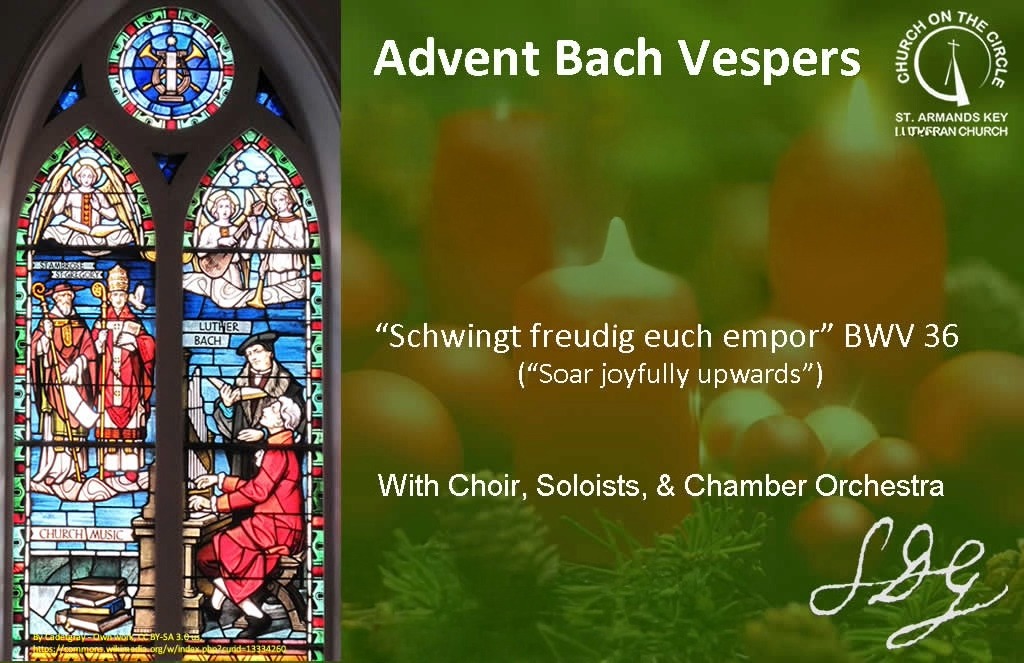
“Schwingt freudig euch empor” (BWV 36) by J. S. Bach – Preformed on December 9th, 2025
ABOUT THE CANTATA
B-A-C-H. These four letters changed the course of music history. Never has there been or likely ever will be a performing or composing talent such as this most notable son who devoted nearly his entire professional musical life to service in the Lutheran Church.
Bach’s known compositions number over 1,100 and cover all musical genres of his day with the exception of opera. Writing primarily to fulfill the needs of the various positions he held, he not only incorporated all the styles and forms available, but developed unsuspected potentialities of each with technical perfection of every detail. Little of Bach’s music was published during his lifetime while the rest remained in handwritten copies. A rediscovery of his music in the early nineteenth century cemented his place in the history of western music for good.
When sitting in church on 2 December 1731, one of the teachers at the St Thomas School would have looked up in surprise. He would suddenly have heard the music that Bach wrote for his birthday six years earlier. The opening chorus was followed by a second surprise. Bach had replaced the recitatives with new chorale arrangements, based on the Advent chorales ‘Nun komm, der heiden Heiland’ and ‘Wie schön leuchtet der Morgenstern’. This was a smart move, as it made it immediately clear that it was an Advent cantata. Everyone knew these familiar and popular church songs, so the tone of this Sunday – looking forward to Christmas – was set straight away.
The secular, festive origins of the music can be heard clearly. The two oboe d’amores are very prominent. In the first aria, about the bride that welcome Jesus as the bridegroom, the oboe is literally used as an instrument of love. In the second part, which was performed after the sermon, the strings are also given an important role in the arias. In the first aria, Jesus is welcomed by the bass as a treasure. All the strings come together in an elegant, festive accompaniment, in which the triplets of the opening section return. In the second aria, in contrast to this tutti accompaniment, there is just one solo violin, which plays con sordine (with mutes). It is a perfect illustration of the words, as the soprano sings: ‘Even with subdued, weak voices God’s majesty is revered’. In between the two arias is a repeat of the melody of the Advent chorale ‘Nun komm der heiden Heiland’, this time with no ornamentation and with long notes in the tenor part, supported by a strict canon from the oboe d’amores. The cantata ends with the same chorale, set for four voices and accompanied by the whole ensemble.
As several versions of this cantata have survived, we are given a glimpse behind the scenes of Bach’s process of composition. In 1725, the piece originated as a secular cantata, written for the birthday of a teacher at the St Thomas School, who has not yet been identified with certainty. In 1726, Bach used the piece again for the birthday of Charlotte Friederike Wilhelmine, princess of Köthen. Later, he brought out the score again and used the music – with new words in the recitatives – as a birthday offering to someone from the Rivinus family of lawyers. Somewhere between 1725 and 1730, he also transformed the secular cantata into church music. In this first sacred version, he used only the arias, and added a final chorale. It was only in 1731 that he composed the
chorale arrangements that appear instead of the recitatives from the original birthday cantata. In all these adaptations, Bach was not concerned with improving the piece or with making the ultimate version. If you compare all the versions, you see that it was more a case of him thinking practically and continually adapting his music to the occasion and the circumstances.
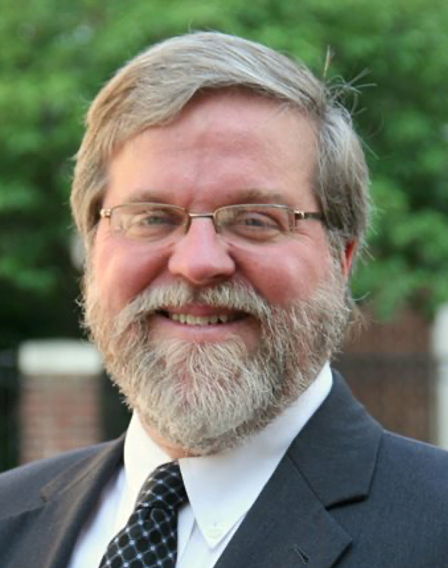
Michael Bodnyk – Conductor
Minister of Music
https://saklc.com/music-ministry/
SAKLC Sunday Singers & Choral Scholars
Soloists:
Michelle Giglio, soprano
Gabriel Welch, tenor
Jesse Martin, bass
Instrumentalists:
Nick Arbolin, oboe d’amore
Kevin Chavez, oboe d’amore
Carlann Evans, violin
Milene Moriere, violin
Matt Pegis, viola
Chris Schnell, cello
Kris Soderman, organ
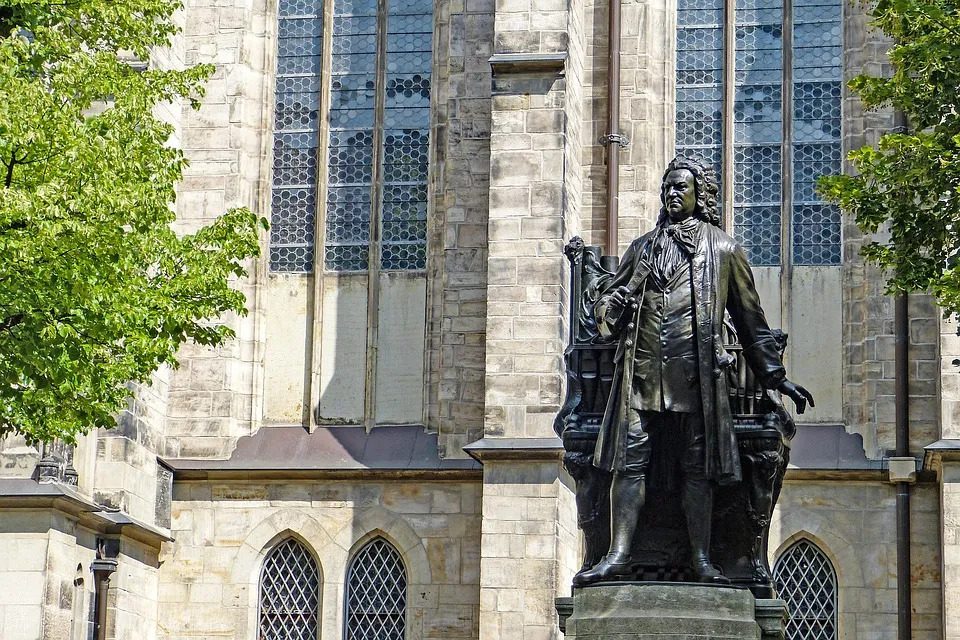
J. S. Bach – Memorial in Leipzig, Germany